
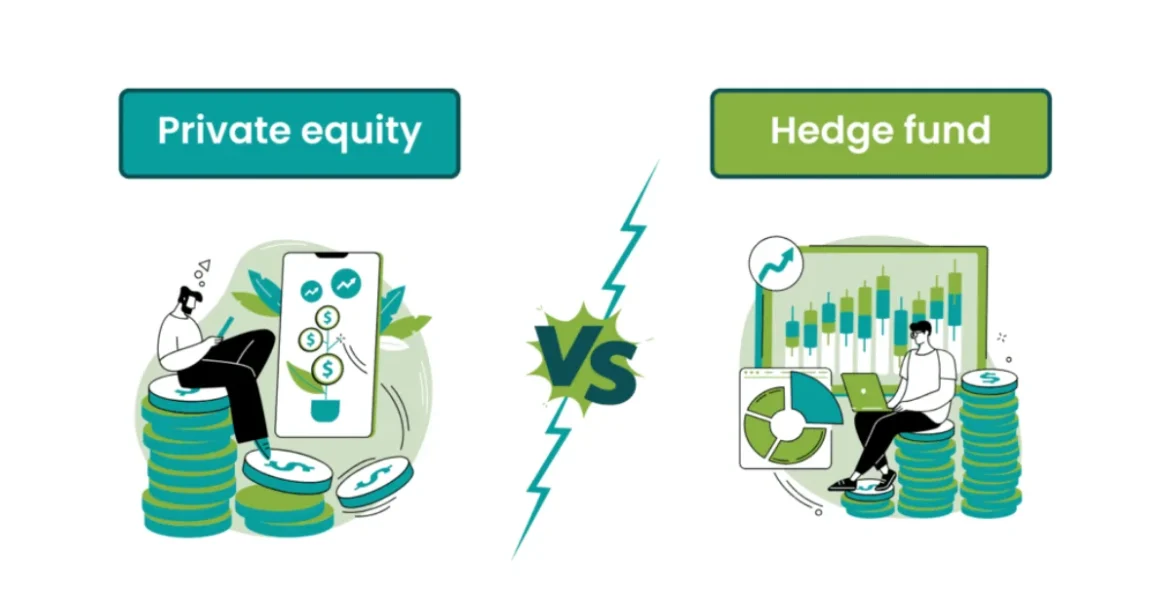
Private equity vs hedge funds for wealthy investors
Private equity vs hedge funds two words that sound similar but mean vastly different things to your wealth.
You’re sitting on millions. Your advisor mentions alternative investments. Two names keep coming up: private equity and hedge funds. You assume they’re basically the same thing. You’re wrong and that mistake could cost you millions in returns and taxes.
Here’s the reality: one locks your money away for a decade while the other lets you withdraw quarterly. One uses massive debt to amplify gains. The other hedges against market crashes. One gets favorable tax treatment. The other doesn’t. Choose wrong, and you’re stuck with the wrong investment for years.
What Is Private Equity vs Hedge Funds?
Private equity refers to investment capital used to buy, improve, and eventually sell companies that aren’t publicly traded.
Imagine a PE firm as a business fixer. They identify underperforming companies, inject capital and expertise, overhaul operations, and sell them for a significant profit years later. The firm raises money from wealthy investors, uses that capital (often combined with borrowed money) to buy entire companies, and controls everything from hiring decisions to strategy to exit timing.
How It Actually Works:
A PE firm raises a fund. You invest, say, $1 million. The fund closes at $500 million total. Managers spend the next 5-10 years buying companies, fixing them, and selling them. When they exit an investment, you receive distributions. When the fund ends, you get whatever’s left. Then you wait for the next fund if you want to continue.
Here’s What Makes PE Different:
- Long-term lock-up: Your money stays invested for 5-10 years minimum
- Active management: PE firms control company operations, not just stock positions
- Majority control: They buy entire companies or controlling stakes
- Leverage: Debt amplifies returns (and risk)
- Illiquidity: You cannot access your capital early, even in emergencies
What Is a Hedge Fund?
A hedge fund is a pooled investment vehicle that uses diverse strategies to generate returns. Instead of buying companies, hedge funds trade stocks, bonds, currencies, commodities, and derivatives. The name hedge comes from their historical focus on reducing risk through short-selling and other protective strategies.
How It Actually Works:
A hedge fund manager collects capital from accredited investors and makes trading decisions daily or weekly. Unlike PE, managers can buy and sell positions quickly. Investors can typically redeem quarterly or monthly, getting their money back on a predictable schedule.
Here’s What Makes Hedge Funds Different:
- Short-term focus: Positions held weeks or months, not years
- Diverse strategies: Long/short equities, global macro, event-driven trades
- Liquidity: You can withdraw money at regular intervals
- Passive role: Managers make all decisions; you don’t control anything
- Continuous operation: No fixed end date; funds operate indefinitely
Alternative Investments Comparison: PE vs Hedge Funds Head-to-Head
| Factor | Private Equity | Hedge Funds |
|---|---|---|
| What They Buy | Private companies, entire businesses | Stocks, bonds, derivatives, currencies |
| Time Commitment | 5-10 years locked up | Monthly or quarterly redemptions |
| Your Role | Active (board seats, strategy input) | Passive (manager decides everything) |
| Liquidity Access | Nearly impossible | Regular intervals available |
| Estimated Returns | 10-15% IRR annually | 6-10% annually |
| Risk Level | Moderate (concentrated positions, leverage) | Moderate-High (market volatility, leverage) |
| Management Fee | 2% of committed capital | 1-1.5% of assets |
| Performance Fee | 20% of profits above hurdle | 15-20% above high-water mark |
PE Investment Strategies Explained
Here is the complete breakdown:
Leveraged Buyouts (LBOs)
A PE firm identifies a $500 million company. They invest $100 million of investor capital and borrow $400 million. By using leverage, they amplify returns. If the company grows and sells for $700 million, investors multiply their money far beyond what they’d earn with just their $100 million.
The downside? That $400 million debt burden crushes the company during recessions. This is why PE performance tanks in downturns.
Growth Capital and Distressed Acquisitions
Instead of buying entire companies, PE invests minority stakes in profitable businesses needing expansion capital. Lower risk, lower returns. Better for risk-averse wealthy investors.
PE firms buy struggling companies at 50-70% discounts, restructure them aggressively, then sell them healthy. High risk, potentially high reward.
Hedge Fund Strategies Explained
- Long/Short Equity: Managers buy undervalued stocks (go “long”) and short-sell overvalued ones. This strategy profits in rising and falling markets theoretically. In practice, it’s harder than it sounds.
- Global Macro: Managers bet on large economic trends. They might buy emerging market currencies, sell developed market bonds, and buy gold simultaneously. These bets play out over weeks or months.
- Event-Driven Trading: Managers profit from specific corporate events: mergers, earnings surprises, bankruptcies. They might buy a company’s stock when it announces a merger, betting the price will rise.
- Multi-Strategy Funds: Diversification across several strategies simultaneously, reducing risk from any single bet.
Performance Analysis of Private Equity vs Hedge Funds Analysis
Estimated Returns (Based on Available Data):
- Private equity: 10-15% annualized
- Hedge funds: 6-10% annualized
PE appears to win. But here’s the catch: PE returns are calculated as IRR (internal rate of return), which accounts for timing. Hedge fund returns are simple annual percentages. They’re not directly comparable.
Moreover, performance varies dramatically by market conditions.
- During bull markets, hedge funds underperform because short positions lose money. PE underperforms because companies are already overvalued.
- During bear markets, PE wins. Company values hold up better than stock prices. Hedge funds with leverage face catastrophic losses.
- During sideways markets, short-selling hedge funds profit. PE funds struggle finding buyers.
The honest truth: Both underperform in some conditions and outperform in others. Neither is universally superior.
Fees: The Silent Wealth Killer
Fees destroy wealth over time. Over 10 years, they can erode 25-40% of gross returns. Understanding exactly what you pay is essential.
Private Equity Fee Structure:
- Management fee: 2% of committed capital (not deployed committed)
- Carried interest: 20% of profits above an 7-8% hurdle rate
Example: Commit $10 million. Pay $200,000 annually in management fees, even if only $3 million is currently deployed in companies.
Hedge Fund Fee Structure:
- Management fee: 1-1.5% of assets (declining from the historical “2 and 20”)
- Performance fee: 15-20% of annual profits above a high-water mark
A high-water mark is crucial: the fund must exceed its previous peak value before earning performance fees. If it drops 20% then gains 15%, it earns zero performance fees that year.
Tax Treatment (Massive Difference):
PE-generated carried interest is often taxed as long-term capital gains. For wealthy investors, this is significantly more favorable than ordinary income rates. Hedge fund short-term trading generates ordinary income, taxed at higher rates. This tax inefficiency is overlooked but devastating.
Net Reality: A PE fund returning 12% gross might net 8-9% after fees. A hedge fund returning 8% gross might net 5-6% after fees. Over 10 years, this compounds into millions in lost wealth.
Liquidity and Lock-Up Periods: Private Equity vs Hedge Funds Access
This is where PE and hedge funds fundamentally diverge.
Private Equity Liquidity:
When you invest in a PE fund, you’re locked in for 5-10 years. No withdrawals. No exceptions. The only escape is selling your stake in the secondary market at a steep discount a slow, expensive process.
Hedge Fund Liquidity:
Most hedge funds allow redemptions quarterly or monthly. You can request your money within these windows. Also this is critical funds can impose “gate provisions” during market stress, trapping your capital for months or years.
During 2008, many funds locked investors out for 18+ months. During 2020 volatility, some imposed similar restrictions.
Practical Impact: If you need flexibility, hedge funds win. If you can afford long lock-ups, PE’s illiquidity is manageable.
Risk Profiles: What Can Actually Go Wrong
Private Equity Risks:
- Leverage backfires during recessions
- Portfolio companies fail despite restructuring
- Exit windows close; you’re stuck holding losers
- Concentrated bets—only 5-10 major investments
Hedge Fund Risks:
- Market crashes amplify leverage-induced losses
- Complex strategies fail during unprecedented conditions
- Counterparty defaults on derivative positions
- Manager blowups from overconfidence
In 2008, PE funds suffered but recovered. Hedge funds with leverage imploded. In 2020, PE benefited buying companies at COVID discounts. Hedge funds experienced sharp volatility.
Volatility Pattern: PE experiences lower volatility (company values don’t change daily). Hedge funds experience higher volatility (market-based pricing fluctuates constantly).
Hedge Fund vs Private Equity vs Venture Capital vs Investment Banking
These four are frequently confused. Here’s the distinction:
- Private equity: Buys established companies, restructures them
- Hedge funds: Trades stocks, bonds, derivatives for short-term gains
- Venture capital: Invests in early-stage startups (highest risk, longest lock-up)
- Investment banking: Advises on mergers, doesn’t invest its own capital
Venture capital is highest risk (most startups fail), PE is moderate risk, hedge funds vary by strategy, investment banking is lowest risk (fee-based).
Which Fits Your Situation?
Choose Private Equity If:
- You have $250K+ to invest
- You can lock capital for 7-10 years
- You want lower volatility
- You value tax efficiency
Choose Hedge Funds If:
- You need quarterly/monthly liquidity
- You want portfolio diversification
- You believe in market timing
- You’re comfortable with higher volatility
Smart Investors: Allocate to both. Example: 60% public markets, 20% PE, 15% hedge funds, 5% other alternatives.
Conclusion
Private equity vs hedge funds serve different purposes. PE offers long-term value creation with lower volatility but requires patience and illiquidity tolerance. Hedge funds offer liquidity and flexibility but typically generate lower returns with worse tax treatment.
The choice depends on your lock-up tolerance, liquidity needs, and tax situation. Work with a qualified financial advisor. Ask about fees, leverage, and tax treatment. Diversifying across both strategies often provides the best risk-adjusted returns.
The wealthiest investors don’t pick one. They allocate strategically to both. For comprehensive guidance on alternative investments and wealth strategies, platforms like Orilea.com can connect you with experienced advisors who understand complex investment structures.
Frequently Asked Questions
What’s the main difference between private equity vs hedge funds?
Private equity vs hedge funds differs fundamentally in approach and time horizon. PE firms buy entire companies for 5-10 years and actively improve operations. Hedge funds trade liquid assets like stocks and bonds over weeks/months. Private equity vs hedge funds boils down to this: PE owns and operates; hedge funds trade and profit from market movements.
Which generates better returns: private equity vs hedge funds?
Private equity vs hedge funds shows PE outperforming with 10-15% IRR versus hedge funds’ 6-10% annual returns. However, after fees and taxes, the private equity vs hedge funds gap narrows significantly. Net-of-fees PE typically delivers 8-9% while hedge funds deliver 5-6%. Over 15 years, this private equity vs hedge funds difference compounds substantially.
How do private equity vs hedge funds differ in fees and taxes?
Private equity vs hedge funds charges: PE (2% management + 20% carry); hedge funds (1-1.5% management + 15-20% performance fee). Critically, private equity vs hedge funds tax treatment differs PE carried interest is taxed as long-term capital gains while hedge fund trading generates ordinary income. This private equity vs hedge funds tax advantage makes PE significantly more tax-efficient for wealthy investors.
Which offers better liquidity: private equity vs hedge funds?
Private equity vs hedge funds differs drastically in liquidity. Hedge funds allow monthly/quarterly redemptions. Private equity vs hedge funds shows PE locking capital for 5-10 years with zero redemption options. Only exit is secondary market sales at steep discounts. If you need capital access, private equity vs hedge funds clearly favors hedge funds.
How do I choose between private equity vs hedge funds, and can I get professional guidance?:
Choose private equity vs hedge funds based on:
- Time horizon: E needs 7-10 years; hedge funds offer flexibility
- Capital amount: both require $500K+ minimum
- Risk tolerance: PE concentrates bets; hedge funds diversify
- Tax situation: PE favors high earners
- Many investors use both: PE for long-term wealth, hedge funds for liquidity.