

Rolex vs Patek Philippe 2025: Value, Investment, Verdict
Rolex vs Patek Philippe 2025 remains one of the most important comparisons in the luxury watch world, especially for buyers in the United States who care about value, credibility, and long-term ownership. While both brands represent the highest level of Swiss watchmaking, they serve very different purposes in today’s market. Therefore, choosing between them is no longer just about prestige it’s about strategy.
In 2025, collectors are more informed, resale-conscious, and selective. As a result, conversations now revolve around investment behavior, durability, and real ownership experience rather than brand mythology. This comparison focuses on facts, market behavior, and practical relevance nothing more, nothing less.
Brand Philosophy and Legacy: Rolex vs Patek Philippe 2025
Although both brands dominate any luxury watch brands comparison, Rolex and Patek Philippe were never designed to appeal to the same buyer. Rolex prioritizes reliability, scale, and universal recognition. Consequently, its watches are built to perform consistently across decades while remaining highly liquid in global markets, including the U.S.
Patek Philippe, however, operates on controlled scarcity and long-term preservation. The brand intentionally limits production and introduces design changes slowly. As a result, it positions ownership as stewardship rather than consumption, which directly shapes how collectors perceive value in 2025.
Craftsmanship and Watchmaking Standards
When comparing Rolex vs Patek Philippe 2025, craftsmanship differences are more strategic than visual. Rolex focuses on industrial precision, durability, and efficiency. Therefore, its movements are engineered for accuracy under daily wear, minimal downtime, and extended service intervals.
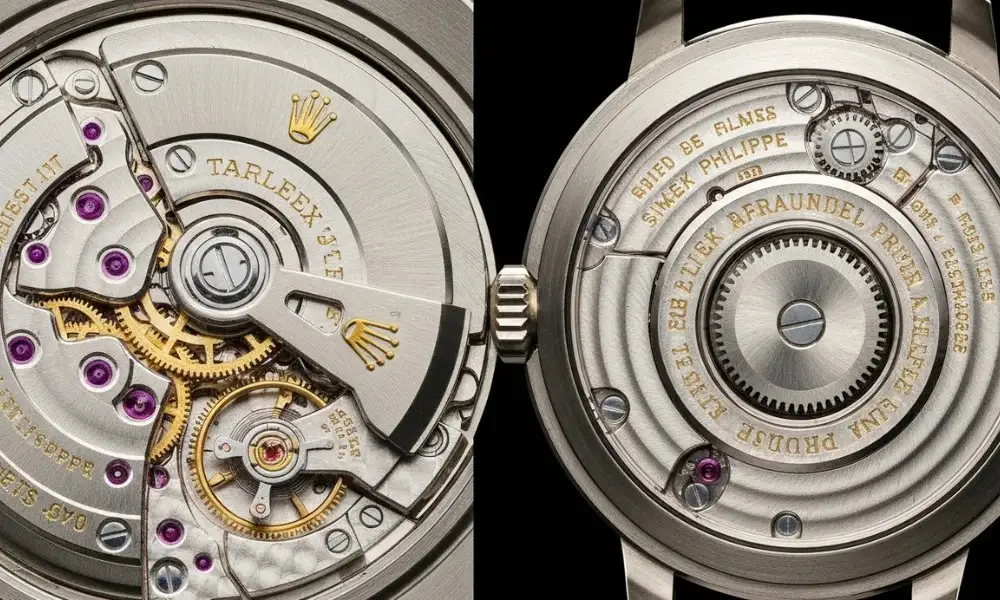
Patek Philippe, by contrast, emphasizes artisanal refinement. Movements are extensively hand-finished, even on internal components. Consequently, while Patek watches demand more careful ownership, they deliver mechanical sophistication that appeals to collectors focused on horological purity rather than rugged performance.
Iconic Models Defining Demand in 2025
In 2025, specific models matter more than brand names alone. Buyers increasingly evaluate performance at the reference level, especially when investment value is involved.
Rolex Daytona: Performance Meets Market Liquidity
The Rolex Daytona continues to dominate the U.S. secondary market due to consistent demand and strong recognition. Moreover, stainless steel references regularly trade above retail, supporting liquidity even during market corrections. As a result, the Daytona remains one of the safest entry points for buyers seeking flexibility.
Patek Philippe Nautilus: Scarcity as a Strategy
The Nautilus benefits from extreme production restraint. Because supply remains limited, demand is driven by scarcity rather than volume. Therefore, price behavior favors long-term holders, especially those comfortable with lower short-term liquidity.
How These Models Shape Buyer Decisions: Rolex vs Patek Philippe 2025
In the Rolex Daytona vs Patek Philippe Nautilus debate, the distinction is clear. The Daytona supports active market participation, while the Nautilus rewards patience. Ultimately, the decision depends on ownership timeline rather than aesthetics.
Investment Performance and Value Retention in 2025
In Rolex vs Patek Philippe investment 2025, data matters more than sentiment. Market indicators such as resale premiums, volatility, and transaction volume provide a clearer picture of performance.
Rolex sports models typically retain 85-95% of retail value during market downturns, with select references maintaining 10-30% premiums on the U.S. secondary market. Because annual production exceeds one million units, liquidity remains high and price discovery efficient.
Patek Philippe produces significantly fewer watches estimated at 60,000-70,000 annually. This limited output supports long-term appreciation, particularly for discontinued or rare models. Over extended holding periods, certain Patek references have demonstrated 200-300% appreciation, although short-term pricing can fluctuate due to lower transaction volume.
Which Watch Holds Value Better: Rolex vs Patek Philippe 2025
From a data-driven perspective, Rolex holds value better in the short to mid-term due to faster resale cycles and broader demand. Patek Philippe, however, often outperforms over longer timelines, where scarcity compounds appreciation. Therefore, value retention depends primarily on holding duration and reference selection.
Buying Considerations: Rolex vs Patek Philippe 2025
For American buyers, ownership extends beyond purchase price. Authorized dealer access, taxation, and insurance all influence the total cost. Rolex maintains a broad U.S. dealer network, which supports service access and resale verification. Although waitlists persist, transaction volume reduces buyer risk. Patek Philippe operates through far fewer retailers, which enhances exclusivity but limits access.
Sales tax varies by state, ranging from 0% to over 10%, directly impacting entry price. Additionally, insurance premiums are typically higher for Patek Philippe due to elevated replacement values. Consequently, U.S. buyers in 2025 must evaluate total ownership cost, not just brand prestige. Similarly, evaluating business strategies, like those implemented by Tesla in 2025, can provide valuable insights into how broader market forces influence pricing and value. Explore Tesla’s 2025 business strategy to understand more about shifting market dynamics and strategic positioning.
Ownership Experience and Long-Term Practicality
In Rolex vs Patek Philippe 2025, daily ownership experience often determines satisfaction. Rolex engineers its watches for regular wear, using robust cases and designing movements that require servicing only every 8-10 years under normal conditions. As a result, they integrate seamlessly into active or professional lifestyles.

Patek Philippe watches, while mechanically superior in finishing, require more careful handling and shorter service cycles, typically 5-7 years. Therefore, long-term practicality depends on whether the owner values ease of use or refinement above all else.
Final Verdict for Modern Collectors
Rolex vs Patek Philippe 2025 is not about superiority it’s about alignment. Rolex excels in durability, liquidity, and predictable performance, making it ideal for buyers who value flexibility and stability. Patek Philippe, however, appeals to collectors with a long-term horizon, where rarity and heritage drive value beyond immediate market conditions.
In 2025, informed ownership matters more than reputation. When chosen with intent, both brands represent not just luxury, but disciplined decision-making rooted in craftsmanship, value, and confidence. Understanding how global financial markets influence luxury investments can enhance your decision-making. Stay updated with global stock market news to make well-informed, strategic choices regarding luxury assets like these timepieces.
Frequently Asked Questions
Is Rolex or Patek Philippe a better investment in 2025?
Rolex offers stronger short-term liquidity, while Patek Philippe delivers higher long-term appreciation for rare references.
Which watch holds value better: Rolex or Patek Philippe?
Rolex performs better short-term; Patek Philippe often outperforms over extended holding periods.
Is the Rolex Daytona better than the Patek Philippe Nautilus?
The Daytona favors liquidity and wearability, whereas the Nautilus prioritizes scarcity and long-term collector value.